 Concrete Calculator Fieldnotes
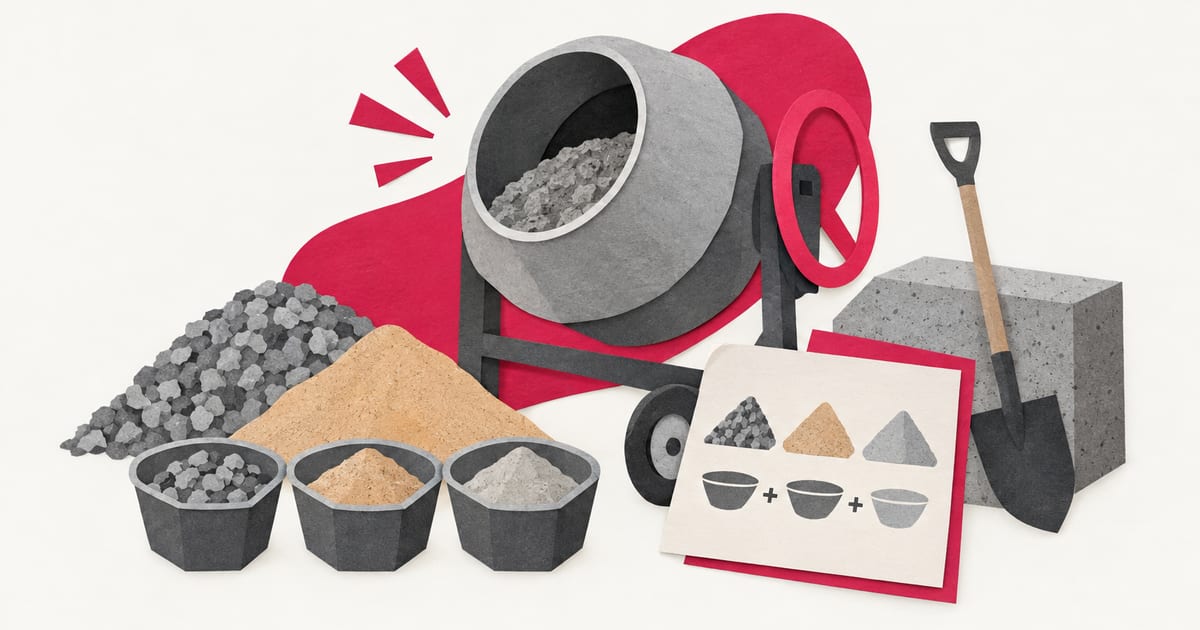
A concrete mixture calculator answers a narrower question than a volume calculator: not just “how much space will this fill?” but “what goes into the mix, and how many bags or parts of each ingredient do I need?” If you are pouring a small slab, setting a fence post, or mixing bagged concrete in a wheelbarrow, it saves you from guessing at ratios and then running short at the worst moment.
Most tools ask for the shape and dimensions, the mix you intend to use, and the bag size if you are buying pre-blended concrete. From there they return a yield in cubic feet or cubic metres, plus bag counts and sometimes a breakdown by cement, sand, and aggregate. The useful ones also let you add a waste allowance, because a perfect theoretical number rarely survives contact with a rough subgrade.
What a Concrete Mixture Calculator Actually Solves
A plain volume calculator tells you that a 10 ft by 10 ft slab at 4 in thick needs about 1.23 cubic yards. That is essential, but it is only half the job. The mixture side tells you whether that volume should be made from 60 lb bags, 80 lb bags, or site-mixed ingredients—and how much water the manufacturer expects. Get the volume right and the mix wrong, and you can still end up with a weak or crumbly pour.
Use a mixture-focused tool when you are working with bagged concrete, when you are mixing from separate ingredients, or when you want a quick check on the number of bags before you load a cart at the store. Use it alongside a concrete slab calculator for flatwork, or a concrete foundations calculator for footings, rather than instead of one. The volume is the foundation; the mix is the recipe.
When not to rely on it: structural concrete, anything requiring an engineer’s mix design, or large ready-mix orders where the supplier will batch to their own specification. In those cases, use the calculator for a sanity check, not as the final word.
How to use a concrete mixture calculator step by step
Measure the pour in consistent units. Length, width, and thickness should all be in inches, feet, or metres—not a mix. Convert thickness from inches to feet before multiplying if your tool expects feet. A 4 in slab is 0.333 ft.
Work out the volume. For a rectangular slab: length × width × thickness. For a footing: width × depth × total length. For a post hole: treat it as a cylinder and use π × radius² × depth. Write the number down; do not re-enter rounded figures at each step.
Choose the mix. Bagged concrete usually states a yield on the bag—often around 0.45 cubic feet for a 60 lb bag and 0.6 cubic feet for an 80 lb bag, but check the bag because brands differ. If you are mixing your own, decide the ratio by volume (for example, 1 part cement to 2 parts sand to 3 parts aggregate) and enter it exactly as the tool expects.
Enter the waste allowance. Five to ten percent is a common planning allowance for uneven ground, spillage, and over-excavation. Small jobs suffer more from waste proportionally, so do not skip it on a wheelbarrow pour. The calculator should add this to the volume, not to the bag count after the fact.
Read the output in the units you will actually buy. A bag count is more useful at the home centre; cubic yards or cubic metres matter when ordering ready-mix. If the tool gives both, check that the bag yield it assumes matches the product in your hand.
Adjust water last. Water changes strength. Add most of the recommended water, mix, then add the rest gradually until the concrete reaches a workable consistency. A mixture calculator can tell you the volume and the bag count; it cannot see how wet your sand is or how thirsty the day is.
Common Mistakes That Throw Off the Numbers
Using the wrong thickness. A “4-inch slab” is often 3.5 in after grading, or 5 in at the thickened edge. Measure the form, not the plan.
Forgetting the base. A slab on a deep gravel base still needs concrete only in the slab; a footing needs concrete through its full depth. Mixing those up is a volume mistake that no recipe can fix.
Trusting one bag yield for every product. High-strength, fast-setting, and lightweight mixes can yield differently. The number printed on the bag wins over a generic assumption.
Ignoring the ratio units. A 1:2:3 mix is usually by volume, not weight. If a concrete mixture calculator asks for weight, do not type in shovel counts.
Ordering exactly to the calculated number. Ready-mix suppliers may have minimum loads and short-load fees; bagged concrete is safer to round up by a bag or two. Running out mid-pour creates a cold joint that is far more expensive than one spare bag.
A Short Worked Example
Suppose you are pouring a 6 ft by 8 ft shed slab at 4 in thick. Volume = 6 × 8 × 0.333 = 16 cubic feet. Add 10% waste: 17.6 cubic feet. With 80 lb bags yielding 0.6 cubic feet each, that is about 30 bags. With 60 lb bags at 0.45 cubic feet, it is about 40 bags. Same slab, very different shopping list—which is why the bag yield matters as much as the volume.
For a small job like that, a mixture calculator is genuinely useful. For a driveway or a large foundation, get the volume checked and let the supplier batch the mix. A concrete slab cost calculator is the better next step if you are comparing bagged concrete with ready-mix pricing, because the bag count is only one line in the budget.
One more check: keep the calculator’s units visible. If you enter feet but read the output as metres, or vice versa, you can be out by a factor of about 35. The arithmetic is simple; the unit discipline is what people actually get wrong.
A concrete mixture calculator is a planning tool, not a guarantee. Measure carefully, use the bag yield printed on the product, add a sensible waste allowance, and treat the result as your starting order rather than a target to hit exactly. Do that, and the pour is far less likely to end with a frantic trip for more bags.
FAQ
How many bags of concrete do I need for a 10 ft by 10 ft slab?
A 10 ft by 10 ft slab at 4 in thick is about 1.23 cubic yards. Divide that volume by the yield printed on the bag—often around 0.6 cubic feet for an 80 lb bag—then add 5–10% for waste. Because bag yields vary by product, check the label before you buy.
Is a concrete mixture calculator the same as a volume calculator?
They overlap, but they answer different questions. A volume calculator gives the space to fill; a concrete mixture calculator turns that volume into bags, parts of cement, sand, and aggregate, or water needs. Use the volume result first, then apply the mix yield or ratio to plan the materials.
What mix ratio should I use for a small slab?
For general non-structural work, a 1:2:3 mix by volume—one part cement, two parts sand, three parts aggregate—is a common starting point. Bagged concrete removes the guesswork. For driveways, structural slabs, or anything inspected, follow the project specification or supplier’s instructions rather than a generic ratio.
How much extra concrete should I order?
Plan on 5–10% extra for level ground and careful forming. Increase that for rough subgrade, deep footings, or a first-time pour where spillage is likely. With bagged concrete, round up to whole bags. With ready-mix, ask about minimum loads and short-load fees before you confirm the order.